 By Thomas Bray
March 8, 2026
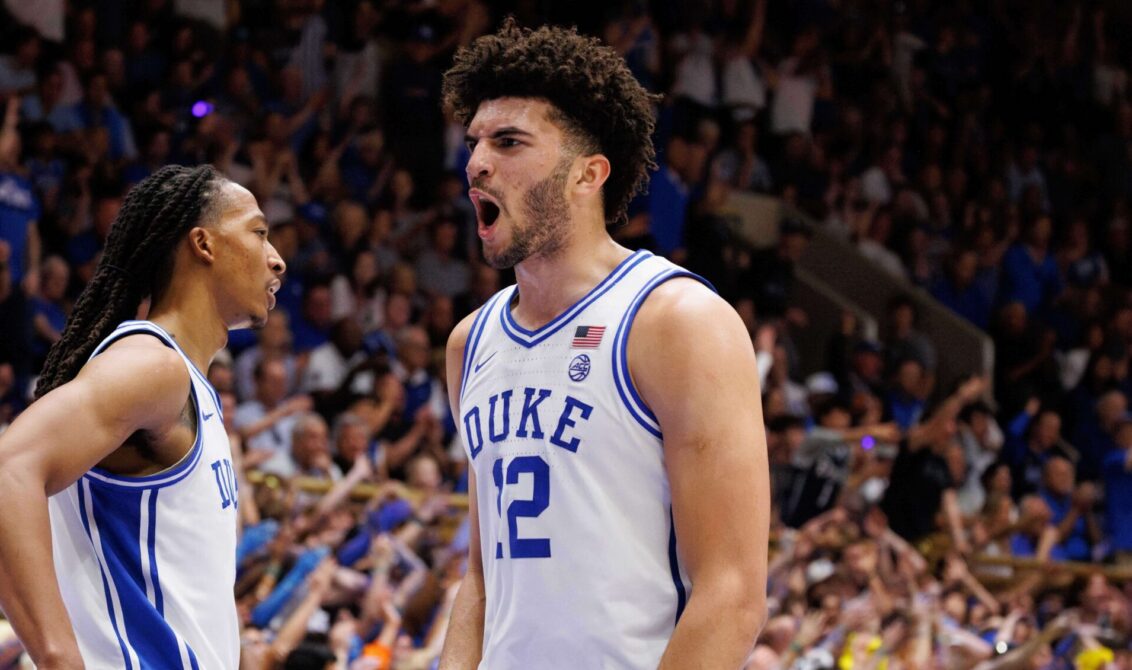
Photo: Ben McKeown / AP
The 2026 ACC Men’s Basketball Tournament returns to the Spectrum Center for the second straight year, with 15 of the conference’s 18 teams competing for the league’s automatic NCAA Tournament bid, improved seeding, and bragging rights.

Charlotte, home to some memorable moments in the 70-plus-year history of the tournament, has hosted the event dating back to the ‘60s at the original Charlotte Coliseum (now Bojangles Coliseum) and later at the Charlotte Coliseum on Tyvola (home of the Hornets) during the ‘90s and early 2000s. It’s also where Hornets rookie sensation Kon Knueppel led his Duke Blue Devils to a conference title and an MVP run last year. This marks the fourth time in the past decade the tournament has been hosted in Charlotte, and it’s slated to return again in 2028.
The ACC is projecting around eight NCAA Tournament bids entering the week — a mark that could swing in either direction depending on how teams perform on a neutral floor. Several programs are playing for their postseason lives, while others are playing for seeding, momentum, and the chance to make noise in March beyond Charlotte.
The 2026 ACC season has been defined by one unmistakable truth: Duke is in a class of its own. The Blue Devils finished the regular season 29-2 overall and 17-1 in conference play, claiming the outright regular-season title and the No. 1 overall seed in both the ACC Tournament and the projected NCAA Tournament bracket.
Outside of Duke, the ACC has been anything but predictable. Virginia, Miami, and North Carolina complete the top four seeds and are all projected safely into the NCAA Tournament, but seeds five through 11 form a tightly contested pack, having traded wins throughout the regular season, creating a web of parity and leaving several programs on the bubble heading into the tournament.
The league’s depth — and its randomness — sets the table for a tournament where the bracket could be completely upended by Thursday morning. In a five-day, win-or-go-home format, execution and strategy will prevail over pedigree.
Let’s break down the top eight teams coming into the ACC Tournament:
No. 1 Duke Blue Devils | Overall: 29-2 | ACC: 17-1 | NCAA Status: Safe
Duke doesn’t just enter the ACC Tournament as the favorite; they enter as one of the most dominant programs in college basketball over the past two seasons, posting a combined 64‑6 record that leads the nation during that span.
The engine of it all is freshman forward Cameron Boozer, who is averaging 22.7 points, 10.2 rebounds, and 4.1 assists per game on 58.3 percent shooting from the field and 40.7 percent from three — numbers that have made him one of the leading candidates for Naismith Player of the Year. Boozer has recorded at least 14 points, five rebounds, and two assists in all 30 games this season, a streak that OptaSTATS notes is the longest by any Division I player this century. Alongside Boozer, sophomore wing Isaiah Evans is averaging 16.2 points per game in ACC play and ranks among the conference’s most dangerous shooters.
Coach Jon Scheyer’s defense has been equally dominant. Duke currently ranks No. 1 in the nation in defensive rating at 87.7, according to KenPom, led by Maliq Brown, who tops the Blue Devils with over 150 deflections and holds the best steal percentage in the ACC. The Blue Devils are overwhelming tournament favorites and are projected as the No. 1 overall seed in the NCAA Tournament. A first-round exit in Charlotte would constitute one of the sport’s greatest upsets.
No. 2 Virginia Cavaliers | Overall: 27-4 | ACC: 15-3 | NCAA Status: Safe
First-year coach Ryan Odom has completely remade the Cavaliers’ roster — 12 newcomers arrived this season — and transformed Virginia into one of the conference’s stronger offensive teams, led by an experienced group of transfers.
The Cavaliers are spearheaded by Thijs De Ridder, who is averaging 15.9 points on 51.3 percent shooting. Virginia also ranks first in the ACC in offensive rebounds and is among the league leaders in blocks. The Cavaliers lost twice to Duke during the regular season, but their path in Charlotte is favorable.
Virginia plays its quarterfinal Thursday afternoon and would avoid a potential Duke matchup until the championship. If Odom’s guards get hot and the 6’9” Belgian De Ridder dominates inside, Virginia is capable of winning the tournament outright.
No. 3 Miami Hurricanes | Overall: 24-7 | ACC: 13-5 | NCAA Status: Safe
The story of the 2025-26 ACC season — outside of Duke — is Miami’s resurrection. A year after finishing 7-24 and failing to qualify for the ACC Tournament, the Hurricanes have matched the school record for regular-season wins under first-year head coach Jai Lucas. Their 17-win improvement over last season is the largest turnaround in all of Division I basketball.
Lucas, a first-time head coach, has built Miami into a more dynamic offensive team. Guard Tre Donaldson has been one of the leaders, averaging 16.8 points and 5.9 assists per game, while freshman guard Noam Dovrat has recently provided perimeter punch — hitting four triples in back-to-back wins against SMU and Boston College. Those victories helped clinch a third-place finish in the ACC and locked the Hurricanes into the No. 3 seed in the conference tournament. Miami enters the ACC Tournament having won nine of its last 12 games.
Miami is safely in the NCAA Tournament picture and carries genuine momentum into Charlotte. A deeper run in the ACC Tournament would only bolster its seeding on Selection Sunday.
No. 4 North Carolina Tar Heels | Overall: 24-7 | ACC: 12-6 | NCAA Status: In
North Carolina enters the ACC Tournament carrying the weight of a brutal week. On Friday, the school announced that freshman star Caleb Wilson — the team’s leading scorer and rebounder and a widely projected NBA lottery pick — broke his right thumb in a non-contact drill during practice and will miss the remainder of the season. Wilson, who had already missed six games while recovering from a fractured left hand suffered February 10 at Miami, was averaging 19.8 points and 9.4 rebounds per game on 57.8 percent shooting before the injury. His absence reshapes everything for Hubert Davis heading into Charlotte.
The Tar Heels went 5-1 without Wilson and did notch one of the season’s signature wins — a 71-68 upset of top-ranked Duke on February 7 at the Dean Smith Center — in which Wilson scored 23 points. But that was with Wilson. What remains is a team built around senior guard Seth Trimble and seven-foot Arizona transfer Henri Veesaar. Trimble scored 30 points in a win at Louisville and was named ACC Player of the Week on March 2. He and the frontcourt transfers will be asked to do more than they have without Wilson running the floor.
A deep ACC Tournament run would do more for Davis’s program culturally than numerically — because without Wilson, the ceiling of what this team can accomplish is significantly lower. They are in the NCAA Tournament regardless, but the question is whether they can remain dangerous once they arrive.
No. 5 Clemson Tigers | Overall: 22-9 | ACC: 12-6 | NCAA Status: In
Clemson Tigers men’s basketball enters the ACC Tournament as one of the most experienced teams in the upper half of the bracket. In his 16th season, coach Brad Brownell has assembled one of his most balanced rosters, anchored by frontcourt depth and a strong defensive identity.
The Tigers have never won an ACC Tournament championship, a frustration that has lingered over the program each March. RJ Godfrey leads the team with 11.7 points per game, but Clemson features several players hovering around double figures.
Their defense — among the best in the conference — makes the Tigers particularly dangerous in a single-elimination setting. No matter what happens in Charlotte, Clemson appears safely in the NCAA Tournament field. However, a few wins could help restore confidence internally and externally after the Tigers dropped five of their final seven conference games to close the regular season.
No. 6 Louisville Cardinals | Overall: 22-9 | ACC: 11-7 | NCAA Status: In
Louisville quietly built a respectable 2025‑26 resume, finishing the regular season 22‑9 overall and 11‑7 in ACC play, highlighted by a quality 92‑89 road win over No. 22 Miami — the program’s first road victory against a ranked opponent since they beat No. 3 Duke in 2020.
The Cardinals’ profile features competitive performances against the ACC’s upper tier and the kind of roster balance that can thrive in neutral-floor tournament play, though inconsistencies and résumé strength have limited their seeding upside. Louisville’s lineup includes freshman phenom Mikel Brown Jr. — a versatile 6’5″ guard with the ability to score at all three levels — although it remains uncertain whether he will play in the tournament due to a lingering lower-back injury. Veterans like Ryan Conwell can score in bunches, as demonstrated by a 31-point performance in a 118-77 win over NC State in February, when he shot 71.4% (10-of-14) from the field and 83.3% (5-of-6) from three-point range, giving the Cardinals a player capable of taking over any game.
Many bracketologists have Louisville in the discussion for a mid‑range NCAA Tournament seed, and a strong showing in Charlotte could enhance their positioning on Selection Sunday.
No. 7 NC State Wolfpack | Overall: 19-12 | ACC: 10-8 | NCAA Status: On the Bubble
Will Wade’s first season in Raleigh has been a reclamation project. After finishing 12-19 a year ago and missing the ACC Tournament entirely, the Wolfpack are 19-12 overall and 10-8 in conference play, back in the league’s upper half. Wade brought elements of his system from McNeese State, including an emphasis on guard play and transfer additions.
NC State is among the ACC teams with five active players averaging at least nine points per game, a statistic that speaks to their offensive depth. Quadir Copeland (13.7 points per game, 49.6 percent shooting) and sophomore Paul McNeil Jr. (13.5 points per game, 41.9 percent from three) form a formidable scoring combination. The Wolfpack enter Charlotte on the bubble and will likely need at least one signature win to feel secure on Selection Sunday.
No. 8 Florida State Seminoles | Overall: 17-14 | ACC: 10-8 | NCAA Status: Need to Win
First-year head coach Luke Loucks, leading the program in the post-Leonard Hamilton era, has built his roster largely through the transfer portal. The team endured a rough stretch from November through January, losing 10 of 12 games, but has since emerged as one of the ACC’s hottest teams, winning 10 of their last 13 behind senior guard Robert McCray V and 6-foot-10 Clemson transfer Chauncey Wiggins. Despite the recent surge, Florida State is not comfortably in the NCAA Tournament field and will likely need multiple wins in Charlotte to strengthen its résumé. Its second-round matchup against No. 9 seed California — a neutral-site game between two bubble teams — is among the most consequential of the tournament’s opening rounds. The loser will likely be watching March Madness from home.
No. 9 California Golden Bears | Overall: 21-10 | ACC: 9-9 | NCAA Status: Need to Win
California enters the ACC Tournament needing wins to save its season. Third-year coach Mark Madsen has guided the Golden Bears to 21-10 — their most in a decade — but a 9-9 ACC record leaves them short of a comfortable at-large resume.
Cal built its résumé on quality wins, including a dramatic 86-85 road victory at Miami and an 84-78 home win over No. 14 North Carolina, but a .500 conference record leaves the selection committee little margin for error.
Madsen has constructed a versatile, perimeter-oriented roster, but the return of 6-foot-10 center Lee Dort from injury late in the regular season has bolstered Cal’s interior presence.
The Wild Card
N.C. State — seeded seventh and facing the winner of the Stanford-Pitt opener — has the analytical profile of a team built to pull off an upset in Charlotte. Quadir Copeland ranks highly in analyst Evan Miyakawa’s player ratings, a recognition of the efficiency and skill he brings on both ends of the floor. He maintains an effective field-goal percentage near 60 percent, making him one of the most efficient players in the conference. Meanwhile, McNeil scored 47 points against Texas Southern in December on 11-of-17 shooting from three — the most by an ACC player since Rodney Monroe had 48 in 1991.
Virginia dealt NC State two of its toughest losses of the season, including a 90-61 blowout in Charlottesville on February 24, when the Cavaliers’ length and defensive pressure kept the Wolfpack in check for much of the night. But tournament basketball on a neutral court in a single-elimination format is a different story. NC State started the season strong and followed it with a six-game winning streak in the ACC during January and early February, showing just how dangerous the team can be when McNeil is knocking down threes and Copeland is running the offense. Even though the Wolfpack stumbled in the final stretch of the regular season, in a 40‑minute game that duo is enough to make any opponent nervous, and the Wolfpack are no strangers to tournament runs after lackluster regular-season finishes.
Duke comes into Charlotte as the overwhelming favorite to cut down the nets, powered by one of the nation’s most talented rosters and a generational freshman in Cameron Boozer. But the ACC Men’s Basketball Tournament is always full of surprises, and with so many bubble teams fighting for their postseason lives and veteran squads carrying a full season of experience, the five days inside the Spectrum Center will be far from a coronation for the Blue Devils.

Read next: