 By Thomas Bray
April 26, 2026
Photo: Carolina Panthers
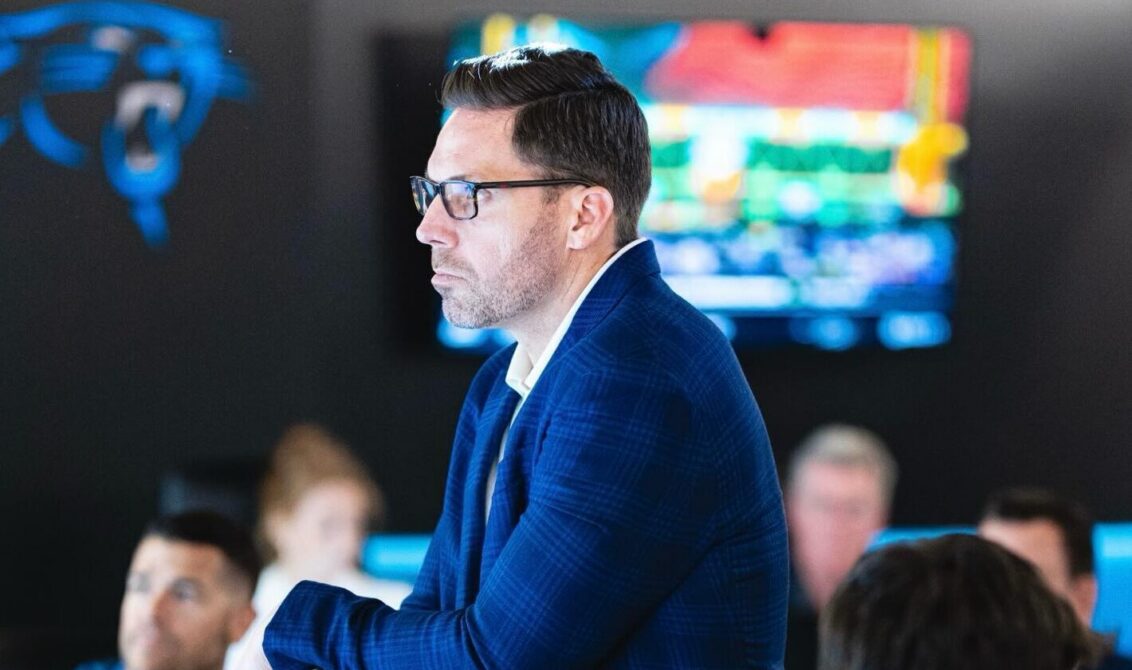
The Panthers entered the 2026 NFL Draft with clear needs, and general manager Dan Morgan addressed one of the biggest by selecting Georgia tackle Monroe Freeling with the 19th overall pick.

Even after a strong free agency period bolstering the offensive line, the logic behind selecting an offensive tackle in the first round was straightforward. Ikem Ekwonu is recovering from a torn patellar tendon and entering the final year of his rookie deal, creating both short- and long-term uncertainty.
Meanwhile, Taylor Moton — the team’s most reliable lineman since being drafted in 2017, with 145 career starts — will turn 32 in August. He has two years remaining on his contract after signing an extension in August and is set to earn a $13 million base salary in 2026 and $20.5 million in 2027.
Given those factors, investing in a young, cost-controlled tackle wasn’t just logical — it was essential. While Morgan and Canales emphasized that Freeling was the best player available at No. 19, it’s hard to imagine offensive tackle wasn’t a high priority for them.
In the second round, the Panthers traded up to secure Texas Tech defensive tackle Lee Hunter, a big, physical, space-eating nose tackle who can hold double teams and free up the linebackers and pass rush.
With their third-round pick, they selected a prospect many believe could be their highest-value selection in Chris Brazzell II, a rangy, fast, prototypical receiver with a large catch radius and the ability to take the top off the defense.
View this post on Instagram
Here’s a complete breakdown of all the Panthers’ 2026 draft picks:
Round 1, Pick 19 — OT Monroe Freeling, Georgia (6’7” / 315 lbs)
The headliner came with a homecoming attached, as Freeling, a 6-foot-7, 315-pound tackle out of Georgia, grew up in Mount Pleasant, South Carolina, just three hours from Bank of America Stadium.
While he started only 17 games over the past two seasons at left tackle for the Georgia Bulldogs, he earned second-team All-SEC honors in 2025. According to Pro Football Focus, he allowed five total pressures in pass protection, including one sack and no hits, committing just two penalties over the course of the 2025 season.
At the NFL Combine, he ran a 4.93-second 40-yard dash with a 33.5-inch vertical — elite athleticism for the position and clear high-upside potential as a premier NFL tackle.
Ekwonu’s injury and contract situation made Freeling a fairly easy decision, even though Carolina also signed Rasheed Walker in free agency to potentially start at left tackle this season, setting up a competition to watch during training camp. He can develop behind a veteran line and step in when the time comes — either as Ekwonu’s replacement at left tackle or Moton’s eventual successor on the right side.
Round 2, Pick 49 — DT Lee Hunter, Texas Tech (6’3” / 318 lbs)
Carolina moved up in the second round to land Lee “The Fridge” Hunter, a nose tackle from Texas Tech whose nickname wasn’t invented, but earned. His high school defensive coordinator gave him the name after telling him, “If people want to eat, they’ve got to get through you.”
Hunter projects as a true gap plugger at the center of coordinator Ejiro Evero’s 3-4 scheme — the kind of interior force that absorbs double teams and helps free edge rushers to work one-on-one.
Derrick Brown — who anchors the Panthers’ defensive front and whom Hunter grew up admiring as an Alabama native with brief stint at Auburn as a redshirt freshman — gets a physical force to open up playmaking opportunities. Both Canales and Hunter himself describe his playing style with one word: violence — and that showed up multiple times on film.
Morgan’s philosophy has not wavered: win the line of scrimmage on both sides, and you have a chance every week.
“The way we play our D-line, like, there’s really not like starters — we’re rotating a bunch, so he’s just gonna be in that rotation. He can play nose, he can play a little D-end in the 3-4, so he brings a lot of versatility,” Morgan said following Day 2 of the draft.
Round 3, Pick 83 — WR Chris Brazzell II, Tennessee (6’4” / 198 lbs)
A receiver who ran the 40 in 4.37 seconds, Chris Brazzell II, a 6-foot-4 wideout out of Tennessee, is the kind of addition that makes a receiver room explosive rather than just deep. Canales — a former receivers coach — said Brazzell was one of his “favorite players in the draft,” with “body control” and an ability to “stretch the field” and “put stress on teams from a vertical standpoint.”
With two big receivers already at the top of the position in Tetairoa McMillan (6’5″) and Jalen Coker (6’3″), Brazzell gives Bryce Young another large target with a wide catch radius. Although he could still use some refinement in his route breaks and against press coverage, he is a legitimate deep threat who can win contested balls and create separation on vertical routes. At No. 83, that combination of frame and athleticism is hard to pass on.
Round 4, Pick 129 — CB Will Lee III, Texas A&M (6’1” / 189 lbs)
After trading back twice in the fourth round, the Panthers selected cornerback Will Lee III out of Texas A&M with the 129th overall pick. Lee fits the mold of a cornerback in Ejiro Evero’s defense as a long, physical defender who can jam receivers at the line and disrupt timing at the catch point. He adds competition and depth to a secondary still taking shape long term, while also providing value on special teams. Although Lee lacks elite long speed to consistently match vertical threats, he offers scheme versatility and has the traits to develop into an eventual starter as a physically aggressive boundary corner in the NFL.
Round 5, Pick 144 — C Sam Hecht, Kansas State (6’4” / 303 lbs)
The fifth round brought center Sam Hecht from Kansas State, who arrives in Charlotte to push free agent acquisition Luke Fortner for the starting job. Multiple analysts flagged him as a Day 2 talent who slid to Day 3, as a highly polished, high-IQ player (a three-time Academic All-Big 12 honoree) with strong technique and processing ability, allowing zero sacks and only two quarterback hits over two seasons as a starter at Kansas State.
If Fortner holds his spot, Hecht becomes a versatile interior depth piece and a potential long-term anchor at center. If Hecht wins the job outright, Carolina lands a starting center without spending much capital. Either outcome represents a very strong value for a fifth-round pick.
Round 5, Pick 151 — S Zakee Wheatley, Penn State (6’3” / 203 lbs)
Carolina traded up a third time on Saturday to select Penn State safety Zakee Wheatley with the No. 151 overall pick. Wheatley brings Big Ten experience as a multi-year starter at Penn State, along with the size and football intelligence that could translate quickly to safety in Ejiro Evero’s defense. With good range and versatility, he fits well within the scheme, showing strong instincts and the ability to play in split-safety shells, rotate into match-zone coverage, and contribute in run support. While he may not have elite top-end speed to consistently match fast receivers vertically or in slot one-on-one situations, he projects well as a scheme fit with his excellent size and length.
Round 7, Pick 227 — LB Jackson Kuwatch, Miami (OH) (6’4”, 235 lbs)
The 2026 draft closed with linebacker Jackson Kuwatch out of Miami (Ohio), a former Ohio State walk-on. Kuwatch had a productive final college season with 109 tackles, 10 tackles for loss, and five sacks, and he projects as a core special teams contributor. He will provide depth as a developmental inside linebacker and bring a high-motor presence that will push competition during training camp.
Morgan and Executive Vice President of Football Operations Brandt Tillis did not swing for a big-name move up in the draft or trade for a veteran player. Instead, they stayed true to their foundational philosophy of drafting and developing physical, high-upside players who love the game. The trenches are stronger, and both the receiver room and secondary have added new blood and increased competition. Coming off their first division title in a decade, a strong free agency period, and now a strong draft class, the Panthers are definitely trending upward heading into the 2026 season.
Read next: