 By
By May 10, 2026
The NBA Draft Lottery results are in, and for Charlotte, things played out largely as expected. With only a 2.4% chance of jumping into the top four, the Hornets did not move up and will now hold two mid‑first‑round picks: No. 14 overall and the No. 18 pick acquired in their 2025 trade with the Phoenix Suns.

This is not unfamiliar territory for Charlotte. The last time the franchise held two picks in a similar range was 2022, when the Hornets traded Jalen Duren, selected 13th overall, to Detroit and drafted Mark Williams at No. 15. That decision has not aged particularly well, but circumstances have changed. A new ownership group and a reshaped front office have brought renewed confidence and, after an impressive 2025 draft class, earned a measure of trust.
What should fans reasonably expect from picks No. 14 and No. 18?
A look back at draft history from the past 15 years helps frame the conversation. While stars have emerged — Bam Adebayo and Michael Porter Jr stand out — but the overall track record is mixed.
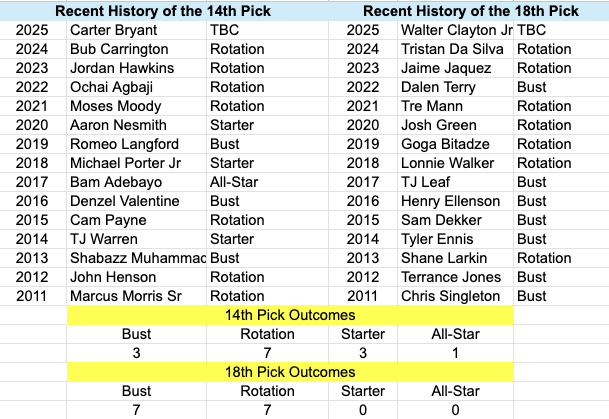
The data highlights a meaningful distinction between the two picks. Players selected 14th overall have nearly a 30% chance of becoming a starter or All-Star and are less than half as likely to bust completely. With the 18th pick, the ceiling has been lower, with rotation players far more common and virtually no high-end outcomes over the same span.
Expectations should be calibrated accordingly, as there is unlikely to be a player at No. 14 or No. 18 making a Kon Knueppel-level impact in their rookie season. Yet this year’s draft may offer more opportunity than the historical baseline suggests. In his end-of-season media availability, Jeff Peterson said, “Top to bottom, this is one of the deepest drafts I’ve been a part of.” That matches league-wide sentiment, making the likelihood of adding legitimate contributors more realistic.
Which brings us to the next question: who are the names to watch as the draft cycle unfolds? I’ve selected three players for each pick who are both projected in that range. We didn’t include any prospects who are consistently projected to be selected in the “Top 12,” as they are likely to be off the board when the Hornets pick.
14th Pick
Labaron Philon
PG | 6’4” | 185 pounds | Age: 20 | Alabama | USA
2026-27 Stats: 30.9 mpg, 22.0 ppg, 3.5 rebounds, 5.0 assists, 1.2 steals, 0.2 blocks FG%: 50.1 3P%: 39.9
We know Jeff Peterson is particularly high on the guard group.
“I’ve really enjoyed watching the guards. There’s a ton in this draft. There are at least 10 guys who are NBA players and will impact the league for a long time.”
Philon could be the seventh guard selected, following a flurry projected to go in the top 10. In most draft classes, he would comfortably be a top‑10 pick himself.
He is skinny but strong, lightning‑quick with the ball, and capable of slicing defenses apart with a unique blend of speed, control, and decision‑making. Philon gets into the paint at will — something few Hornets can do — thanks to his burst, and once there, his read‑and‑react game is advanced. He can blow past defenders and finish with either hand, use touch floaters, spray kick‑outs to shooters, or deploy one of his biggest weapons: a sharp deceleration step that consistently draws fouls.
Complementing that is Philon’s shooting threat. He’s knocking down 39.9 percent of his threes on volume, highlighted by a signature self‑created stagger step‑back three that is extremely difficult to guard.
After declaring for the draft last year, Philon returned to school and delivered a true breakout season. While his defense dipped under the burden of a heavy offensive role, he showed in his freshman year that he can be a disruptive on‑ball defender. At the NBA level, surrounded by more offensive options, there’s hope he can rediscover that defensive impact, though his slender frame will limit his overall versatility on that end.
Team Fit:
Philon wouldn’t address an immediate need assuming Charlotte re‑signs Coby White, as there would be no clear short‑term path to consistent minutes. However, if either LaMelo Ball or White were to miss time, the Hornets would otherwise be relying on Sion James to run the offense. Philon would provide high‑end insurance and offer a ready‑made long‑term starter waiting in the wings should roster changes occur down the line.
Karim Lopez
SF/PF | 6’8” | 220 pounds | Age: 19 | New Zealand Breakers | International (Mexico)
2026-27 Stats: 25.8 mpg, 11.9 points, 6.1 rebounds, 2.0 assists, 1.2 steals. 1.0 blocks, FG%: 50.2, 3P%: 33.0
Lopez is Mexican by nationality but has spent the last two seasons with the New Zealand Breakers through the NBL’s Rising Stars program. At 6’8” and 220 pounds, he already has prototypical NBA forward size while still being just 19 years old.
He uses that frame well, excelling as a downhill attacker who can finish through contact while also showing comfort handling the ball like a guard in spurts. That stands out in a physical league like the NBL, where he’s already outmuscling experienced professionals despite his age.
His shooting took a step forward this season, as he converted 40% of his open threes but just 25% of contested attempts, highlighting that shot consistency remains a swing skill. If the jumper stabilizes, Lopez has the makings of a well‑rounded offensive player.
Defensively, however, is where his NBA translation becomes more complex. While his size and strength are appealing, he lacks quick feet on the perimeter and isn’t a high‑end vertical athlete. He struggles switching onto guards, navigating screens, and closing out consistently. According to a late season NBL broadcast, Lopez had the fourth‑highest foul rate in the league, a clear indicator that he’s still adjusting defensively.
Team Fit:
Lopez would immediately give Charlotte a downhill scorer capable of playing through contact and generating rim pressure, something this perimeter‑oriented roster lacks. While he would need defensive improvement to become a starter, his length, strength, and respectable steal and block numbers in limited minutes suggest there is upside if he develops on that end.
Jayden Quaintance
PF/C | 6’10” | 255 pounds | Age: 18 | Kentucky | USA
2024-25 Stats (Arizona State): 29.7 mpg, 9.4 points, 7.9 rebounds, 1.5 assists, 1.1 steals, 2.6 blocks, FG%: 52.5% 3P%: 18.8
Quaintance is the true wildcard of the 2025-26 draft. If healthy, he would almost certainly be a top‑10 pick. However, concerns surrounding his recovery from a February 2025 ACL tear have pushed his projected range as low as the 20s.
When fully healthy at Arizona State during the 2024–25 season, Quaintance was one of the most ferocious freshman defenders in the country, doing so at just 17 years old. He boasts a rare combination of speed, athleticism, strength, length (7’5” wingspan), and elite anticipation that made him a genuine defensive game‑changer.
Offensively, he was raw but not devoid of skill, flashing playmaking feel and shooting touch in spurts. What’s missing is time. He simply hasn’t had enough court reps over the past 12 months to smooth out those rough edges. Viewed in totality, Quaintance was considered a generational defensive prospect with real offensive upside — and then came the injury.
After tearing his ACL in February 2025, Quaintance transferred to Kentucky and, following questionable guidance, returned to game action in December 2025 — fewer than nine months post‑surgery. Typical ACL recovery timelines run closer to 11-12 months. Unsurprisingly, after just four games, he experienced swelling in the repaired knee and was shut down for the remainder of the season.
NBA teams have plenty of questions, but there is at least transparency. Agents are now required to share independently evaluated medical data from the Chicago Draft Combine with all teams, ensuring clubs like Charlotte would fully understand the medical risk before making a decision.
Team Fit:
If healthy, Quaintance is the type of defender who can fundamentally alter a team’s identity. With none of Charlotte’s core trio — LaMelo Ball, Kon Knueppel, or Brandon Miller — grading out as high‑level defenders, adding a true defensive anchor to erase mistakes and take on elite matchups would fill a major need. The question is whether the Hornets, having seen two recent seasons derailed by injuries, are willing to take on another significant medical gamble.
18th Pick
Koa Peat
SF/PF | 6’8 | 235 pounds | Age: 19 | Arizona | USA
2025-26 Stats: 14.1 points, 5.6 rebounds, 2.6 assists, 0.6 steals, 0.7 blocks, FG%: 52.8 3P%: 35.0
Koa Peat plays exactly like you’d expect the son of a former NFL offensive lineman to play — because he is one. Physical strength is his defining trait: he routinely overpowers defenders and is capable of guarding up a position thanks to his thick frame. That strength advantage has followed him at every level.
However, Peat isn’t just a bruiser. Offensively, he has a polished — if somewhat retro — scoring package. He’s comfortable operating in the mid-post, where he relies on a dependable turnaround jumper and a variety of drop steps and spin moves to finish within 15 feet. While undeniably strong, he isn’t a high-end vertical athlete in tight spaces, often needing a runway to elevate — similar to Brandon Miller, who has at times struggled to consistently rise through contact in the half court.
The concern is how that skill set translates to the modern NBA, where spacing and three-point volume are paramount. While Peat shot 35% from beyond the arc, the number is misleading given he attempted just 20 threes all season. A 62.3% free-throw percentage and a slight hitch in his shooting release only add to the shooting concerns.
Even with the jumper remaining a question mark, Peat brings value in other areas. He’s an outstanding passer for his size, consistently making creative and timely reads, and he plays with a high motor on the glass. Defensively, he’s already a smart team defender and was Arizona’s vocal leader on that end, serving as the primary communicator. His résumé reflects winning at every stop: four state championships in high school, a gold medal with Team USA at the FIBA U19 World Cup, where he started, and a key role on an Arizona team that reached the Final Four.
Peat’s strength has been the foundation of his game throughout his young career. The pivotal question is whether that advantage will hold at the NBA level. If he can no longer physically overwhelm opponents, does he have a clear, reliable NBA-caliber skill to lean on?
Team Fit:
With Miles Bridges and Grant Williams’ contracts set to expire after next season, Peat could give the Hornets a potential long-term answer at power forward. He would immediately add much-needed physicality to the roster, and his offensive limitations could be mitigated by Charlotte’s existing shooting around him. While he may sit lower on some mock drafts, Peat’s work ethic, leadership, and proven winning pedigree align closely with what the organization prioritizes. For that reason, he feels like a strong fit with the Hornets’ identity and long-term vision.
Hannes Steinbach
PF/C | 6’11” | 220lb | Age: 20 | Washington | Germany
2025-26 Stats: 18.5 points, 11.8 rebounds, 1.6 assists, 1.2 blocks, 1.1 steals, FG%: 57.7, 3P%: 34.0
Hailing from the same German hometown as NBA legend Dirk Nowitzki, Steinbach took the college route, spending his freshman season at Washington. Rebounding is the trait most likely to earn him early NBA minutes, as he was among the nation’s elite on the glass last season. He has strong, bucket-like hands that consistently swallow up boards, particularly on the offensive end, where he shows a unique knack for timely putbacks.
That said, Steinbach is more than just an energy rebounder. He’s flashed legitimate perimeter skill, including three-point range, the ability to operate as a ball-handler in inverted pick-and-rolls, attack closeouts, and deliver eye‑catching passes on rolls to the rim or out of dribble handoffs. The issue is consistency. Those flashes raise the question of whether these skills can become foundational parts of his offensive game — or if they merely hint at upside that may never fully materialize at the NBA level.
Defensively, the evaluation is mixed. According to Synergy, Steinbach held opponents to just 40% shooting at the rim, an impressive number on paper. However, the tape tells a more nuanced story. He can be slow to rotate and provide help, and he lacks natural rim-protection instincts, compounded by average length for his height and limited vertical explosiveness. Outside the paint, he’s often late to contests and gives shooters ample space, likely compensating for his slow foot speed and fear of being beaten off the dribble. Still, there are standout moments, such as his impressive isolation defense against potential No. 1 pick AJ Dybantsa during the FIBA U19 World Cup final last summer, that showcase what he can do when locked in.
Catching up on FIBA U19 film, exceptional defensive sequence by Hannes Steinbach on AJ Dybantsa.
That’s an eye opener folks pic.twitter.com/EncrZKlkot
— James Plowright (@British_Buzz) May 7, 2026
Team Fit:
Charlotte places a premium on rebounding, and Steinbach would only strengthen that identity. He also brings more perimeter skill than current options like Diabate or Kalkbrenner, giving him a chance to fill in at center in the right matchups. If his shooting becomes more consistent, he could even slide to power forward in double-big lineups — aligning with the league’s gradual shift back toward size and versatility up front.
Morez Johnson Jr.
PF/C | 6’9” | 250 pounds | Age: 20 | Michigan| USA
2025-26 Stats: 13.1 points, 7.3 rebounds, 1.2 assists, 0.7 steals, 1.1 blocks, FG%: 62.3, 3P%: 34.3
After struggling to earn consistent playing time as a freshman at Illinois, Johnson rebuilt his profile with a strong showing at the FIBA U19 World Cup, where he won gold, before transferring to Michigan and contributing to a national championship run.
Johnson possesses the skillset of a center but is undersized at only 6’9”. He spent much of this season playing power forward alongside towering 7’3” big man Aday Mara — himself a potential Hornets target. In terms of playstyle, there are clear parallels to Charlotte’s Moussa Diabate that make playing center in certain lineups feasible. He’s a ferocious rebounder, strong as an ox, yet fluid for his size, and comfortable switching onto perimeter players. When pulled into the paint, he leverages his 7’3 wingspan to defend the rim. His defensive versatility is his biggest NBA skill.
Offensively, Johnson benefited greatly from being part of an excellent Michigan team that consistently put him in advantageous positions. His role was largely limited to that of a play finisher — scoring on drop-off passes, dunks, and putbacks around the rim. Still, there are indicators of untapped shooting potential: he shot 34% from three on low volume (0.9 attempts per game) and an encouraging 78.2% from the free-throw line.
Motor is never a problem. Johnson plays nonstop, regularly beating opposing bigs down the floor in transition and relentlessly pursuing the ball. That energy often results in fouls and trips to the free-throw line, adding value even on possessions where he isn’t directly involved in the play call.
While Johnson projects as a relatively safe pick, his upside is limited. He struggles to create offense for himself or others and shows very little touch on floaters, layups, or mid-range attempts. When he tries to expand his offensive responsibilities, loose handles, clumsy footwork, and questionable decision-making frequently lead to turnovers. Even some basic passes can be wildly inaccurate, highlighting an overall lack of offensive feel. For Johnson to develop into a legitimate starter, the three-point shot will need to become a reliable weapon — allowing him to function as a versatile, defense-first 3-and-D forward.
Team Fit:
Early in his career, Johnson would likely fill a role nearly identical to Moussa Diabate’s, which could limit his immediate path to playing time. However, with Diabate set to become a free agent in 2027 — unless extended beforehand — Johnson could serve as a cost-effective, long-term replacement who preserves the team’s defensive energy and rebounding identity.
Read next: