 By Cameron Lee
May 16, 2026
Rarely does an ensemble of vocal powerhouses come together on one stage like Patti LaBelle, Chaka Khan, Gladys Knight, and Stephanie Mills will in Charlotte this month for The Queens Tour. Together, they represent a decades-spanning catalog that has shaped generations of R&B, soul, and pop, while also serving as a foundational source of samples and inspiration in hip-hop.
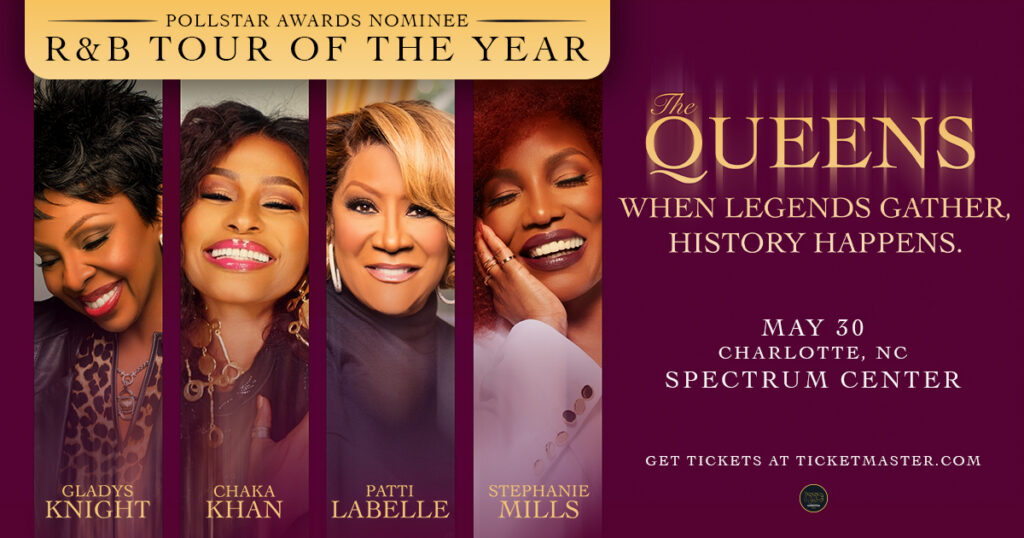
The Queens Tour will stop in Charlotte on May 30 at the Spectrum Center, offering a rare opportunity to see four of music’s most influential voices share one stage, each backed by a lush live band. Across the ‘60s, ‘70s, and ‘80s, each artist helped define the sound of her era through landmark recordings and unforgettable live performances that expanded the global reach and cultural impact of Black American music.
With 20 Grammy Awards collectively, the tour stands as more than a celebration of individual catalogs. It is a living tribute to enduring artistry, cultural resilience, and the legacy of four women whose voices helped shape the emotional and musical vocabulary of modern music.
Patti LaBelle
Often referred to as the “Godmother of Soul,” Labelle is known for her effortlessly dynamic dramatic soprano and gospel-infused melisma. Born Patricia Louise Holte in Philadelphia, she was given the stage name “Patti LaBelle” — meaning “the beautiful” in French — by music promoter Bernard Montague, who worked with her first group, the Ordettes, in the ‘60s.
Evolving into Patti LaBelle and the Bluebelles, she earned early recognition with songs like “You’ll Never Walk Alone” and the doo-wop ballad “Down the Aisle.” In the early ’70s, the group reinvented itself as Labelle, adopting a funk-rock and soul-driven style and achieving its first No. 1 hit with “Lady Marmalade,” which made history by becoming the first chart-topping single by an all-Black female group. The song was later reimagined by Christina Aguilera, Mýa, Pink, and Lil’ Kim for the 2001 film Moulin Rouge!, further cementing its popularity.
By the late ‘70s, LaBelle launched her solo career, leaning into R&B and pop with hits throughout the ‘80s and ‘90s such as “If Only You Knew,” “New Attitude,” “On My Own,” “Love, Need and Want You,” and “Somebody Loves You Baby.” She later expanded into acting and cooking, appearing in films and television shows including A Soldier’s Story, American Horror Story: Freak Show, and as Lena James in a recurring role on A Different World.
LaBelle’s enduring legacy as a defining voice in Black American entertainment is firmly established with a career spanning more than six decades across group, solo, and crossover pop success — all rooted in her early beginnings singing in church at Beulah Baptist Church in Philadelphia.

Gladys Knight
The Southern queen of the quartet, the “Empress of Soul” Gladys Knight, was another church-raised prodigy whose career began at an early age. As a teenager, she formed a family vocal group that would eventually evolve into Gladys Knight & the Pips, later becoming one of the crown jewels of the legendary Motown era. The group first broke through with “Every Beat of My Heart” before cementing itself as one of soul music’s defining acts through timeless hits like “I Heard It Through the Grapevine,” “If I Were Your Woman, Friendship Train,” and “Neither One of Us (Wants to Be the First to Say Goodbye).” Following their departure from Motown, the group reached even greater heights with their signature anthem, “Midnight Train to Georgia,” a song that became permanently embedded in the fabric of American soul music.
After the release of the group’s final album, All Our Love, in 1987 and a farewell tour the following year, Knight transitioned seamlessly into a flourishing solo career. Even before the official end of the Pips, she had already expanded beyond the boundaries of traditional soul music, joining Dionne Warwick, Stevie Wonder, and Elton John on the 1985 AIDS benefit single “That’s What Friends Are For.” The song became a global No. 1 hit and Grammy winner, elevating Knight into a broader pop-cultural spotlight while showcasing her ability to move effortlessly between soul, pop, and adult contemporary music.
Knight’s solo career reached its commercial peak with the release of Good Woman in 1991, her most successful solo album, featuring the Babyface-written collaboration “Superwoman” alongside fellow icons Patti LaBelle and Dionne Warwick. That same year, Knight and LaBelle reunited for “I Don’t Do Duets” on LaBelle’s album Burnin’, further highlighting the chemistry between two of R&B’s most celebrated voices. Her 1994 album Just for You earned a Grammy nomination, while At Last (2000) delivered her first solo Grammy Award for Best Traditional R&B Album.
Gladys Knight & the Pips were inducted into the Rock and Roll Hall of Fame in 1996, and in 2022, Knight received the prestigious Kennedy Center Honors for her lifetime contributions to American culture through the performing arts, adding to a résumé that also includes the National Medal of Arts. With a voice defined by warmth and elegance, Knight’s influence stretches across generations of soul, R&B, gospel, and pop artists, cementing her status as one of the most enduring voices in American music.
Chaka Khan
A vocal force in R&B, funk, soul, pop, and even hip-hop, Chaka Khan emerged in the early ’70s as the dynamic frontwoman of Rufus. Khan helped usher in a new era of funk-infused soul with a string of groundbreaking hits that blended tight musicianship with her unmistakable voice. Early classics like “Tell Me Something Good” (written by Stevie Wonder), “You Got the Love,” “Once You Get Started,” and “Sweet Thing” showcased a rare combination of raw power, jazz-influence, and emotional depth that quickly set Rufus apart as one of the defining bands of the decade. By the late ’70s, the group’s momentum continued with records like “Do You Love What You Feel,” further solidifying Khan as a transformative figure in popular music.
Her transition into a solo career in the ‘80s elevated her to global superstardom. The release of “I’m Every Woman,” written by the legendary songwriting duo Nickolas Ashford and Valerie Simpson, became an instant anthem of empowerment and identity, establishing Khan as a cultural icon in her own right beyond the band. The track would later gain renewed global recognition through Whitney Houston’s iconic cover, further extending its legacy across generations. She followed with “Ain’t Nobody” (1983), one of the most enduring R&B and pop songs of the era, defined by its hypnotic groove and her explosive, gospel-rooted vocal delivery.
Her ballad “Through the Fire” became a cornerstone of modern sampling culture, famously reimagined by Kanye West for his breakout single “Through the Wire,” introducing her music to an entirely new generation. Across five decades, she has sold tens of millions of records worldwide and remains one of the most frequently sampled female vocalists in music history.
With 11 Grammy Awards and her 2023 induction into the Rock & Roll Hall of Fame, Chaka Khan’s legacy is both critical and cultural. Her voice — equal parts thunder and silk — has influenced generations of artists across genres, from R&B and funk innovators to modern pop and hip-hop.
Stephanie Mills
While Patti LaBelle, Gladys Knight, and Chaka Khan first rose to prominence through groups and bands, Stephanie Mills carved out a different path to stardom on Broadway. Mills became a household name starring as Dorothy Gale in the original, seven-time Tony Award-winning run of The Wiz from 1974 to 1979, delivering what remains one of the most iconic performances in Black musical theater. But before The Wiz transformed her into a star, Mills was already proving herself a prodigious talent, appearing in the Broadway musical Maggie Flynn at just nine years old and winning Amateur Night at the legendary Apollo Theater six consecutive weeks as a child.
Her breakout role in the groundbreaking all-Black adaptation of The Wizard of Oz established Mills as a defining theatrical voice of her generation, but it also became the launching pad for a highly successful recording career. The Bedford-Stuyvesant, Brooklyn native found mainstream commercial success with her 1979 album What Cha’ Gonna Do with My Lovin’, which became her first Gold-certified project. She followed with 1980’s Sweet Sensation, featuring her crossover smash “Never Knew Love Like This Before,” a song that earned Mills the Grammy Award for Best Female R&B Vocal Performance.
Throughout the ’80s, Mills emerged as one of the defining voices in contemporary R&B, earning five No. 1 R&B hits with songs including “Home,” “I Have Learned to Respect the Power of Love,” “I Feel Good All Over,” “(You’re Puttin’) A Rush on Me,” and “Something in the Way (You Make Me Feel).” Her 1987 album If I Were Your Woman achieved Platinum certification and produced multiple chart-topping singles, while her 1989 album Home also reached Platinum status.
Among the first generation of Black actresses to successfully leverage Broadway stardom into major recording industry success, Mills’ influence continues to resonate.
Together, Patti LaBelle, Gladys Knight, Chaka Khan, and Stephanie Mills represent more than just four legendary singers sharing a stage — they are pillars of Black American music history whose careers collectively helped shape the sound, style, and emotional language of modern R&B and soul. From gospel and doo-wop to funk, disco, Broadway, and pop crossover success, each artist redefined what was possible for Black women in entertainment during eras when opportunities were still heavily restricted by race and gender.
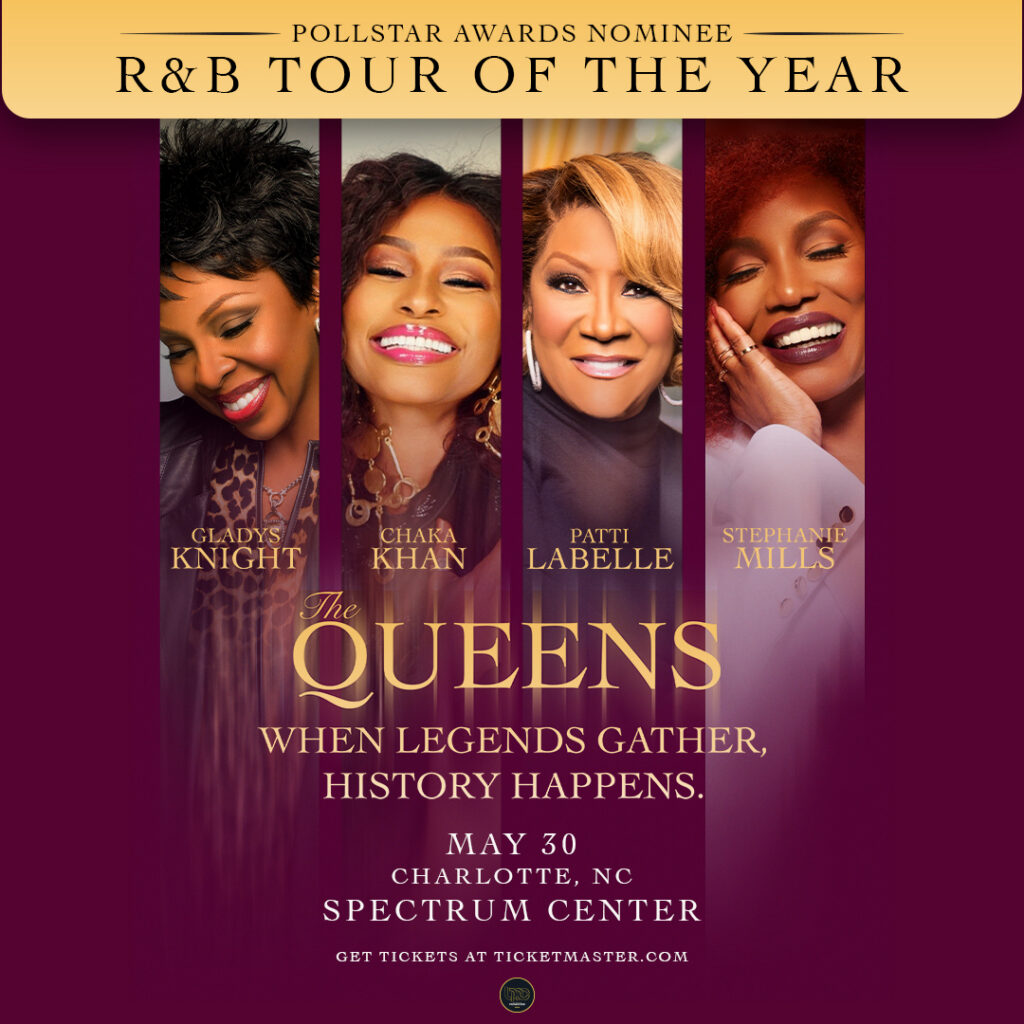
The Queens Tour, featuring Patti LaBelle, Gladys Knight, Chaka Khan, and Stephanie Mills, arrives in Charlotte at the Spectrum Center on Saturday, May 30.
This article is brought to you ad-free by the Black Promoters Collective and Hornets Sports & Entertainment.

Read next: