 By
By June 19, 2026
Charlotte holds picks 14 and 18 in what is widely considered a deep and talented 2026 NBA Draft class that begins to taper off in the 20s. The Hornets have a real opportunity to strengthen their exciting young core by adding high-end talent and, if the board falls their way, addressing key areas of need.

For this mock draft, we used ESPN’s Draft Simulator to keep the projections as realistic as possible. Let’s take a look at how the board could unfold leading up to Charlotte’s selection at No. 14 on Tuesday night.
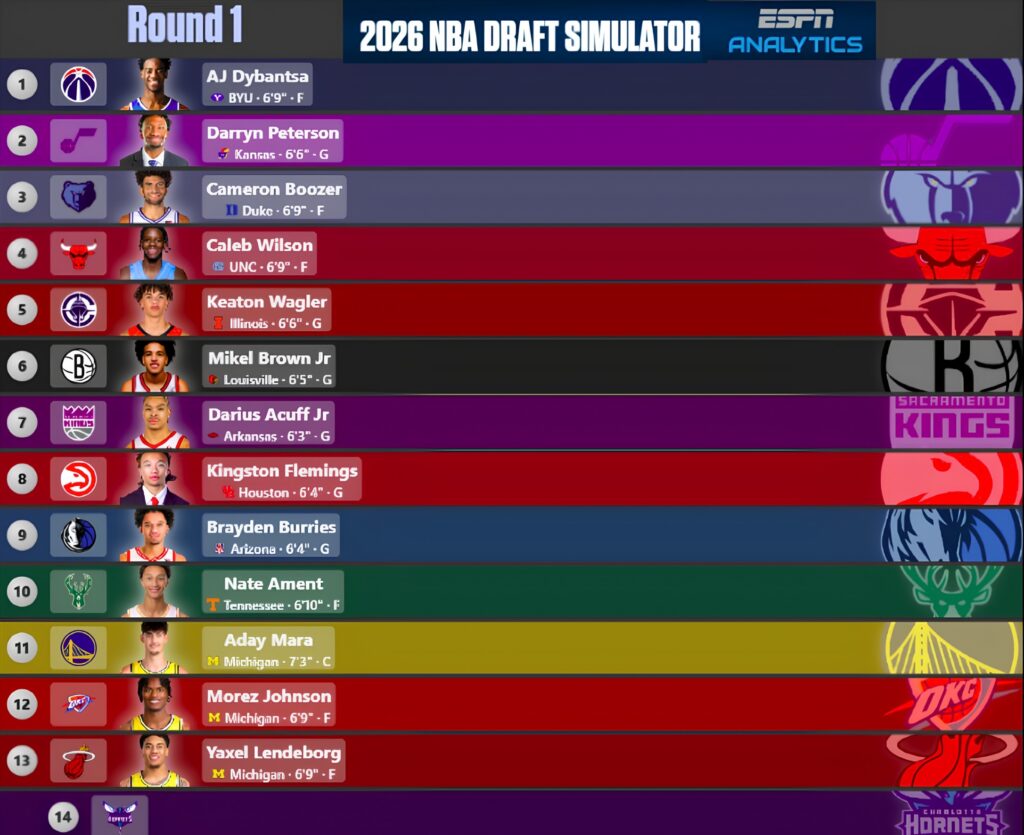
In this mock, it’s a little disappointing, though not entirely surprising, that none of the three Michigan prospects are available for Charlotte at No. 14. Aday Mara, Morez Johnson, and Yaxel Lendeborg each bring different strengths to the table, but all three could address key needs for the Hornets. Mara and Lendeborg have long been projected to come off the board before No. 14, but a late surge in Johnson’s draft stock has shifted the conversation.
The primary target for this spot in the mock was Johnson, so there’s a sense of frustration in seeing him selected just before the Hornets are on the clock. While this simulation does not include trades, the real draft could unfold very differently. If Johnson is indeed the Hornets’ preferred target, Charlotte could explore moving up to secure him. Teams such as Dallas at No. 9, Milwaukee at No. 10, and Oklahoma City at No. 12 have all been linked to potential trade-down scenarios or even exiting the draft entirely. With pick No. 18 in hand, along with a surplus of future draft capital, the Hornets have the flexibility to put together a competitive offer if they choose to be aggressive.
With those options off the board, the focus shifts to the remaining prospects available. Here’s who we think would be the best selections if the Hornets stay put at 14 and 18.
Pick No. 14: Hannes Steinbach – 6’11” Power Forward (University of Washington)
The selection of Hannes Steinbach in this mock draft is largely driven by how his profile would give Charlotte’s frontcourt a completely different dimension, particularly with their emphasis on rebounding. Steinbach’s production on the glass stands out immediately, as he pulled in 11.8 rebounds per game in his freshman season and consistently generated extra possessions through sheer motor and awareness. He doesn’t just collect boards; he creates offense from them with tip-ins, tip-outs and quick outlet passes, fitting neatly into a rebounding-first identity while adding far more offensive versatility than Charlotte’s current options.
Offensively, he projects as a dynamic piece in the Hornets’ system, especially as a driver in inverted pick-and-rolls. His ability to attack from the perimeter as a big, absorb contact, and stay balanced to finish gives him real scoring upside, complemented by flashes of pick-and-pop shooting, midrange touch, and improving three-point accuracy. Around the rim, his 68% finishing rate and soft floater game make him a reliable interior option who can also punish mismatches with quick, decisive scoring moves.
Another major factor in this selection is Steinbach’s playmaking feel, which adds important connective value. He has shown he can operate as a dribble-handoff hub, making smart reads and displaying the ability to find teammates with skip passes out of doubles or well-timed drop-offs when drawing help downhill. His negative assist-to-turnover ratio should be viewed in context, as Washington’s system placed a heavy burden on him to score, something he would not be asked to replicate at the next level, at least not immediately. This blend of rebounding and passing awareness allows him to impact possession flow in multiple ways.
Defensively and from an intangibles standpoint, Steinbach provides a strong foundation with room to grow. He competes hard, plays through contact, and maintains discipline, which is reflected in opponents shooting around 40% at the rim against him despite modest block numbers. He uses verticality effectively, contests without fouling, and stays active with his hands to disrupt interior actions. While there are concerns about his lateral quickness and help timing, his effort level and physicality stand out consistently. There are also rare, but unique flashes of defensive upside, such as the clip below where projected No. 1 pick AJ Dybantsa isolated him on the perimeter, and Steinbach slid defensively before blocking his attempt.
Catching up on FIBA U19 film, exceptional defensive sequence by Hannes Steinbach on AJ Dybantsa.
That’s an eye opener folks pic.twitter.com/EncrZKlkot
— James Plowright (@British_Buzz) May 7, 2026
Pick No. 18: Karim Lopez – 6’8” Forward (New Zealand Breakers)
After the selection of Steinbach, Karim Lopez surprisingly slid in this simulation, with Carr, Stirtz, and Philon all going ahead of him.
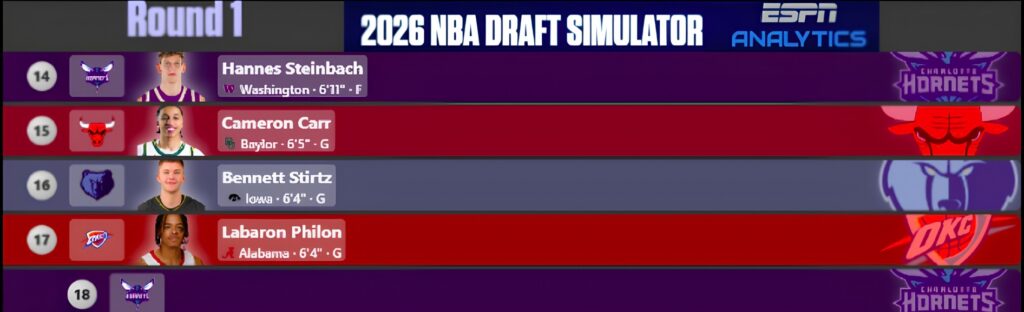
The Thunder at No. 17 feel unlikely to actually make the selection of Lopez. With the No. 12 pick already in hand and ongoing roster-crunch considerations, a trade seems more probable. This opens the door for another team to capitalize on what is shaping up to be a very deep point guard class. In that context, the simulated selection of Philon, who has also been linked as high as Miami at No. 13, feels entirely plausible.
Not many basketball fans have seen Lopez play, as he spent the past two seasons in the Australian NBL. However, he has professional experience and has shown encouraging growth as a defender, shooter, and decision-maker.
At 6-foot-8 with a 6-foot-11 wingspan and a powerful 222-pound frame, Lopez possesses a rare combination of size and strength for a perimeter player. He excels at getting downhill, creating for others, and finishing through contact in the paint. That skill set aligns closely with one of Charlotte’s biggest needs, and the spacing created by Charles Lee’s offensive system should allow him to thrive when attacking the interior.
Although he shot just 32.6% from three this season, there are clear signs of upside. He converted nearly 43% on unguarded catch-and-shoot three-point attempts, suggesting that in a structured offense that generates clean looks, there is real potential for improvement.
It’s not all force with Lopez, here he gets low, shows some wiggle and handle to get downhill with his left hand and finish.
That’s an NBA caliber move right there pic.twitter.com/S4sVXmgQPV
— James Plowright (@British_Buzz) May 22, 2026
Defensively, Lopez remains very raw and prone to mistakes. He was one of the weaker defenders in the NBL this past season. However, what separates him from many prospects who struggle on that end is his flashes of defensive instinct. He averaged 1.5 blocks and 1.6 steals per 36 minutes and has the size, length, and strength that could allow him to develop into a solid defender if he fully commits to that side of the ball.
Where Steinbach appears more NBA-ready, Lopez may require more time before he earns a consistent role in the rotation. That said, Charlotte is in a position to be patient. With Miles Bridges and Grant Williams set to expire in 2027, and Tidjane Salaün’s development still uncertain, adding another bigger-bodied, perimeter-oriented forward fits naturally into the team’s longer-term timeline.
Other prospects under consideration at No. 18 include Arizona’s bruising power forward Koa Peat and Texas Tech’s sharpshooting guard Christian Anderson Jr. A notable omission is Jayden Quaintance, who began the season as a projected top-five pick by ESPN and would theoretically address Charlotte’s defensive needs. However, concerns around his surgically repaired knee during the pre-draft process have not been alleviated. With so much talent available, it’d difficult to see the Hornets taking that level of risk.
The 2026 NBA Draft will take place on Tuesday, June 23 (8:00 p.m.) and Wednesday, June 24 (8:00 p.m.) at Barclays Center in Brooklyn, New York, and will air live on ESPN.
Read next: